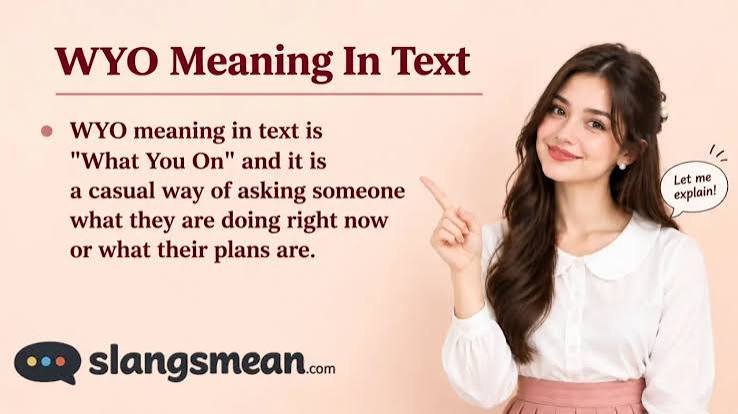
wyo meaning in text is most commonly understood as “what you on?”—a casual way of asking what someone is doing, what they are up to, or what plans they have. Like many internet abbreviations, WYO belongs to a broader culture of shortening everyday language for quick digital communication. Its meaning is usually straightforward, but the tone can shift depending on who sends it, the relationship between the people, and the surrounding conversation.
Understanding What WYO Means in Everyday Messages
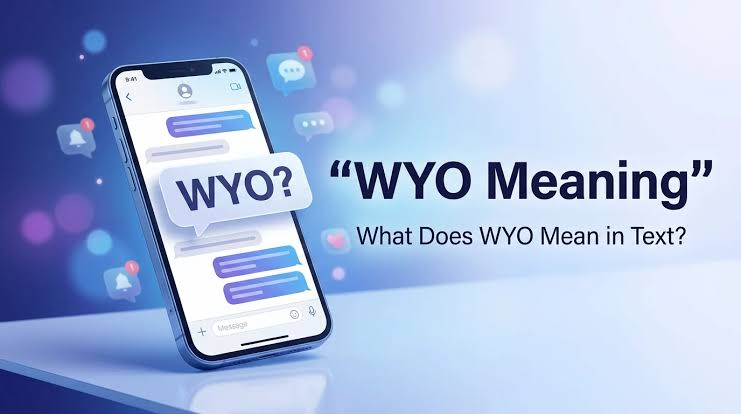
When someone types “WYO?” in a text, they are generally asking about your current activity or plans. In practical terms, it can function similarly to “What are you doing?” or “What are you up to?” However, its informal construction gives the message a relaxed, conversational quality.
For example, a friend might send “WYO tonight?” when they want to know whether you have plans. Likewise, “WYO rn?” can ask what you are doing at that moment. Therefore, the abbreviation is particularly useful when people want to communicate quickly without writing a complete sentence.
Why Short Expressions Like WYO Became Popular
The rise of texting, social media, and instant messaging has changed the way people write. Instead of treating digital messages like formal correspondence, users often write in a style that resembles spoken conversation. Consequently, abbreviations such as WYO became natural parts of online communication.
Speed is one reason. Another is social familiarity. A short expression can make a message feel less formal and more spontaneous. In addition, digital communication often rewards brevity because conversations move rapidly. Rather than writing a longer question, someone can simply type three letters and rely on shared cultural understanding.
How Context Changes the Meaning
Although the basic interpretation is relatively consistent, context matters. A message saying “WYO?” between close friends may simply be an invitation to talk. Meanwhile, “WYO this weekend?” could be a way of asking about someone’s availability.
The relationship between the speakers also affects the tone. Between friends, the phrase may sound casual and friendly. From someone you barely know, however, it can feel more direct. Therefore, understanding the wyo meaning in text is not only about expanding the letters; it also involves recognizing the social situation surrounding them.
WYO Compared With Other Common Text Abbreviations
Digital communication contains many abbreviations that perform similar conversational functions. However, each has its own emphasis and tone.
| Expression | Common meaning | Typical purpose |
|---|---|---|
| WYO | What you on? / What are you up to? | Asking about activities or plans |
| WYD | What are you doing? | Asking about someone’s current activity |
| WYA | Where you at? | Asking someone’s location |
| HBU | How about you? | Returning a question |
| HMU | Hit me up | Inviting someone to contact you |
These expressions overlap, but they are not interchangeable in every situation. For instance, WYD focuses more directly on what someone is doing, while WYO can have a broader sense of asking what someone is involved in or planning.
The Conversational Personality Behind Three Letters
Part of the appeal of WYO is its informality. Digital language often removes unnecessary structure while preserving the emotional purpose of communication. As a result, an abbreviation can sometimes feel more natural than a grammatically complete sentence.
This reflects a wider cultural change. People increasingly move between formal and informal language depending on the platform. An email to a teacher, employer, or organization may require complete sentences, whereas a conversation with a friend can rely heavily on abbreviations, emojis, and fragments.
Thus, WYO is not simply a shortcut. It represents the flexibility of contemporary communication.
When Someone Sends “WYO?” What Are They Really Asking?
The safest interpretation is usually simple: they want to know what you are doing or what you have going on.
For example:
- “WYO?” — What are you up to?
- “WYO later?” — What are you doing later?
- “WYO this weekend?” — What plans do you have this weekend?
- “WYO rn?” — What are you doing right now?
Nevertheless, the intended meaning can depend on the conversation. If someone has already been discussing plans, WYO may naturally refer to those plans rather than the person’s immediate activity.
Why Tone Matters More Than Grammar
One interesting feature of internet slang is that grammar often becomes secondary to social meaning. WYO does not follow the conventions of formal written English, yet most experienced texters can understand it immediately.
That is because digital language operates through shared expectations. People recognize patterns, abbreviations, and conversational shortcuts because they encounter them repeatedly. Consequently, the meaning is often understood almost instantly without mentally translating every letter.
This is similar to how spoken language uses contractions and informal expressions. In both cases, efficiency works because the participants share a linguistic framework.
Is WYO Formal or Informal?
WYO is strongly informal. It is appropriate for casual digital conversations but generally unsuitable for professional emails, academic assignments, formal letters, or official communication.
If you are speaking with a close friend, however, using WYO can make the conversation feel natural. In a professional setting, a clearer phrase such as “What are you working on?” or “Do you have any plans?” would normally be more appropriate.
The distinction is important because good communication is not simply about knowing vocabulary. It is also about knowing when a particular expression fits the situation.
The Broader Culture of Texting Language
WYO belongs to a much larger vocabulary created and popularized through digital communication. Expressions such as LOL, BRB, IDK, BTW, and WYD have become recognizable far beyond their original online communities.
Over time, some abbreviations become so familiar that they enter everyday speech or appear in mainstream media. Others remain closely connected to specific platforms, age groups, or online communities. Therefore, internet slang is constantly changing rather than functioning as a fixed dictionary.
That fluidity is one reason searches for phrases such as wyo meaning in text remain common. People encounter unfamiliar abbreviations every day, particularly as new social platforms and communication styles develop.
How to Respond When Someone Says WYO
The response depends on what you are actually doing. There is no special formula required.
You might answer naturally with something like:
- “Just relaxing.”
- “Doing some homework.”
- “Nothing much, you?”
- “I’m out with family.”
- “Getting ready for tomorrow.”
If the person appears to be asking about plans, you can respond with your availability instead. The goal is simply to continue the conversational exchange.
Frequently Asked Questions
What does WYO stand for in texting?
WYO commonly means “what you on?” and is generally used to ask what someone is doing, involved in, or planning.
Is WYO the same as WYD?
They are similar but not identical. WYD traditionally means “what are you doing?” while WYO can have a somewhat broader, highly informal meaning related to what someone is up to.
Is WYO slang?
Yes. WYO is informal digital slang and is primarily associated with casual texting and online conversations.
Can WYO be used professionally?
Generally, no. Because it is informal and abbreviated, it is better suited to casual conversations than professional or academic communication.
The Meaning Behind the Abbreviation
Ultimately, wyo meaning in text is a small example of how language adapts to technology. Three letters can replace a longer question because digital communication depends heavily on speed, familiarity, and context. At the same time, the expression illustrates how modern language is shaped by relationships and social settings.
What makes WYO interesting is not merely its abbreviation. It is the way such a compact expression can open a conversation, ask about someone’s world, and establish a relaxed tone almost instantly. In that sense, WYO represents a broader truth about language: communication continually changes to fit the ways people connect.