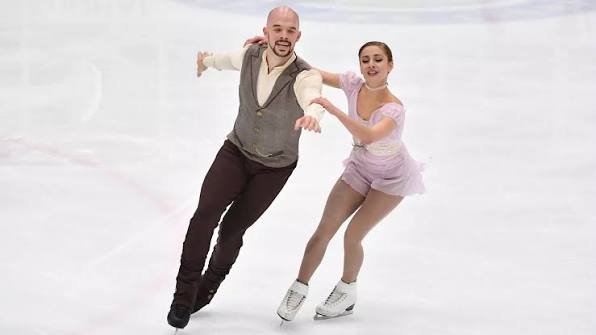
Tarah Kayne and Danny O’Shea represent a significant chapter in modern American pair skating, a discipline where athletic ability must be matched by timing, trust, and an almost instinctive understanding between two performers. Their partnership produced national and international success while also illustrating how a skating pair develops an identity that goes beyond individual talent.
Although their competitive partnership eventually ended, their accomplishments remain part of the broader story of U.S. figure skating. Together, they became U.S. champions in 2016 and won the Four Continents Championships in 2018, establishing themselves as one of the notable American pairs of their era.
Who Were Tarah Kayne and Danny O’Shea?
| Skater | Background | Notable achievement with the partnership |
|---|---|---|
| Tarah Kayne | American pair skater from Fort Myers, Florida | 2016 U.S. champion; 2018 Four Continents champion |
| Danny O’Shea | American pair skater from Pontiac, Michigan | 2016 U.S. champion; 2018 Four Continents champion |
| Partnership | Began competing together in the early 2010s | Developed into an established U.S. senior pairs team |
Kayne was born in Fort Myers, Florida, in 1993 and began skating in 1998. O’Shea, born in Pontiac, Michigan, in 1991, started skating in 1995. Their different beginnings eventually converged in Colorado Springs, where they trained as a senior pairs team. Official U.S. Figure Skating records list their training base and competitive achievements among the defining details of their partnership.
The Making of a Successful Pair
Pair skating is unusual because individual skill is only part of the equation. A successful team must coordinate jumps, spins, lifts, transitions, musical interpretation, and movement across the ice. Consequently, the partnership itself becomes almost like a third element of the performance.
For Kayne and O’Shea, that process developed over years rather than overnight. They made their senior U.S. Championships debut together in 2013, according to Team USA, and gradually became established contenders. Their progress demonstrated the importance of consistency and communication in a discipline where even a small difference in timing can affect an entire sequence.
From National Contenders to U.S. Champions
The breakthrough came at the 2016 U.S. Championships, where Kayne and O’Shea captured the national title. That achievement was especially important because American pairs skating has historically featured intense competition for the opportunity to represent the country internationally.
Their national victory gave the partnership a stronger platform. More importantly, it confirmed that the pair had developed beyond promising potential and had become genuine leaders within the American field. U.S. Figure Skating’s historical championship directory records Kayne and O’Shea as the 2016 U.S. pairs champions.
The 2018 Four Continents Triumph
Their international breakthrough arrived at the 2018 Four Continents Championships, where they won gold. The achievement remains one of the most important results associated with the partnership.
Four Continents brings together leading skaters from countries outside Europe, making it an important international event for American, Canadian, Asian, and other skating nations. Winning there requires more than technical ability; it requires the capacity to perform under international pressure.
For Kayne and O’Shea, the title represented years of development translated into a major championship result. The International Skating Union identifies O’Shea as the 2018 Four Continents champion with Kayne, while later U.S. Figure Skating records continue to cite that victory as one of his major accomplishments.
Why Pair Skating Is About Trust
The story of Kayne and O’Shea also reveals something fundamental about pairs skating. Unlike singles competition, the athlete cannot rely exclusively on personal rhythm or individual recovery. Every major element depends on two people responding to one another.
A lift, for example, is not simply a demonstration of strength. It involves timing, balance, positioning, and confidence. Likewise, side-by-side elements demand remarkable synchronization. Therefore, the emotional dimension of pair skating can be just as important as the visible athleticism.
That is why established pairs often develop a distinctive performance identity. The audience is not merely watching two skaters; it is watching a relationship between movement, music, and trust.

A Partnership Measured in More Than Medals
The official ISU record shows that Kayne and O’Shea achieved a personal-best international total of 194.29 at the 2019 Golden Spin of Zagreb. Their international results also included strong Grand Prix and Challenger Series performances.
Their competitive career was therefore not defined by one championship alone. Instead, it consisted of several seasons of development, international appearances, national competition, and increasingly sophisticated programs.
That longer perspective matters. In elite sport, medals provide the simplest way to measure achievement, but they do not always capture the work behind them. Training, injuries, changing programs, competition pressure, and the constant demand for technical refinement all form part of an athlete’s career.
The End of One Chapter
After nearly nine years together, the partnership ended in December 2020, according to Team USA. O’Shea subsequently retired from competitive skating before briefly returning to competition with Chelsea Liu in 2021.
The conclusion of a skating partnership can be particularly significant because pairs spend years building highly specialized coordination. Nevertheless, the end of a competitive partnership does not erase what the athletes achieved together.
Instead, it becomes part of their professional histories. Kayne’s legacy includes her national and international success with O’Shea, while O’Shea’s later career would take him into a very different chapter of American pairs skating.
Danny O’Shea’s Later Career
O’Shea eventually returned to elite competition with Ellie Kam. The pair officially teamed up in 2022 and developed rapidly, later becoming 2024 U.S. champions. Their career reached another landmark when Kam and O’Shea won gold in the team event at the 2026 Olympic Winter Games.
That later success adds an interesting perspective to his earlier partnership with Kayne. Rather than representing the conclusion of his skating story, the Kayne-O’Shea era became one important stage in a much longer sporting journey.
O’Shea has also pursued interests beyond competition, including education and work connected with real estate and skating. The ISU lists him as a skating coach and real estate investor, while Team USA notes his education at the University of Colorado Colorado Springs.
The Lasting Meaning of Their Partnership
Tarah Kayne and Danny O’Shea are remembered not simply because they won medals, but because their partnership captured the demanding nature of pairs skating. Their journey moved from early senior competition to a U.S. championship and eventually to a Four Continents title.
Moreover, their story demonstrates how athletic careers rarely follow a straight line. Partnerships begin, evolve, succeed, and eventually end. Yet the skills and experiences developed along the way continue influencing what comes afterward.
For fans of figure skating, that may be the most compelling part of their story. A competitive record provides dates and results, but the deeper narrative concerns perseverance, trust, adaptation, and the ability to transform years of difficult training into moments that remain memorable long after the music stops.
Conclusion
Tarah Kayne and Danny O’Shea occupy a meaningful place in American pairs skating history. Their 2016 U.S. championship and 2018 Four Continents victory stand as clear markers of a partnership that reached the highest levels of national and international competition.
Yet their importance extends beyond those achievements. Their career illustrates the human side of elite skating: the patience required to build trust, the discipline behind synchronized movement, and the resilience required when one chapter comes to an end.
Ultimately, their partnership is best understood not as a finished statistic but as a piece of a larger sporting story—one in which years of collaboration created performances, achievements, and memories that continue to shape how their careers are remembered.