Introduction
ONB meaning in text is usually connected with the slang expression “On Bro,” a casual phrase used to emphasize honesty, seriousness, or strong agreement. In a digital world where conversations move quickly, three letters can sometimes carry the emotional weight of an entire sentence. Rather than simply stating an opinion, a person may use ONB to signal that they genuinely mean what they are saying. The expression belongs to the constantly changing language of texts, group chats, comments, and social media, where tone is often compressed into remarkably short forms.
Why Short Expressions Matter in Digital Conversation
Modern messaging has created an environment where language is increasingly economical. People often communicate through abbreviations, initials, emojis, and shortened phrases because speed and informality matter.
However, these expressions are not merely shortcuts. They can also provide emotional cues. A simple sentence may sound uncertain, while adding a familiar slang expression can make it feel more sincere or emphatic.
Consequently, ONB works less like a conventional noun or verb and more like a conversational marker. It tells the reader how strongly the writer wants the statement to be understood.
The Everyday Meaning Behind ONB
In casual online communication, “On Bro” is generally used to reinforce a statement. Depending on the sentence, it can be understood as something close to “I swear,” “for real,” “I’m serious,” or “I’m telling the truth.”
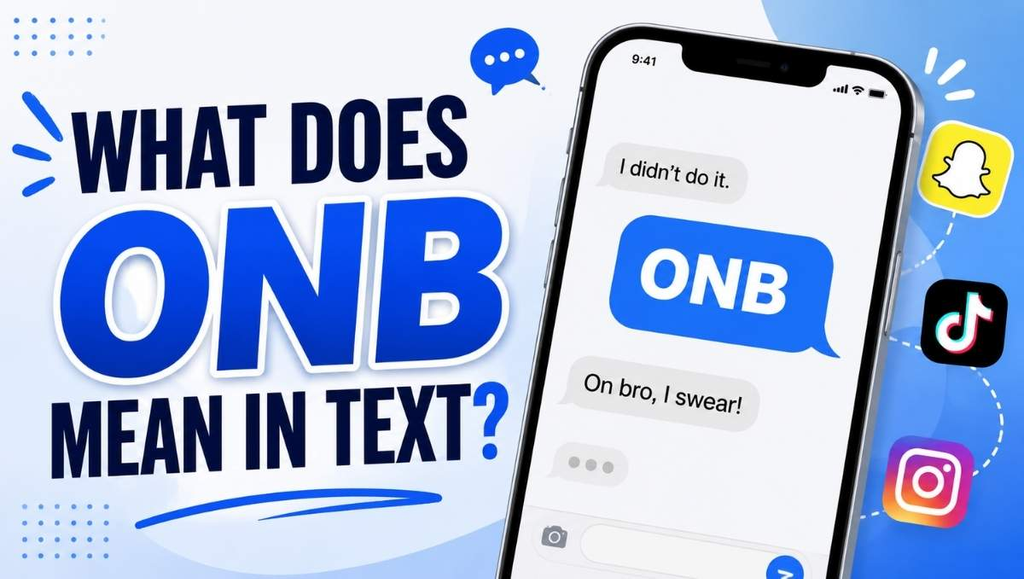
For example, someone might write, “ONB, I didn’t know about it.” The important part is not simply the information itself. The abbreviation adds emphasis, suggesting that the speaker wants the other person to believe the claim.
Likewise, it can strengthen an opinion. A message such as “That was actually hilarious, ONB” gives the impression that the writer genuinely stands behind the reaction.
How ONB Adds Emotion Without Adding Many Words
Text messages lack many of the signals present in face-to-face conversation. There is no voice, facial expression, or immediate body language to communicate whether someone is joking, serious, surprised, or enthusiastic.
Therefore, internet slang often performs some of that emotional work.
ONB can function as a small signal of sincerity. It tells the reader that the preceding statement should be taken seriously or understood as strongly felt. In this sense, slang becomes a kind of digital body language.
Interestingly, this is one reason abbreviations can become culturally meaningful. They do not simply shorten language; they help replace some of the context that disappears when conversation moves onto a screen.
ONB Meaning in Text and the Importance of Context
Although “On Bro” is a common interpretation, abbreviations are rarely universal. The surrounding sentence, relationship between speakers, platform, and subject of the conversation can all affect interpretation. Current online references also note alternative meanings for ONB, including less-common slang and context-specific uses.
For that reason, reading the entire message is usually more useful than interpreting the three letters in isolation.
Consider the difference between:
“ONB, I never said that.”
and:
“I’m ONB with the plan.”
The first looks like informal slang emphasizing a statement. The second could potentially be interpreted differently depending on the conversation.
Thus, context remains the most reliable guide.
Where the Expression Appears
The abbreviation is particularly associated with informal digital communication. It can appear in text messages, social media comments, direct messages, group conversations, gaming chats, and other casual online spaces.
On social platforms, short expressions can spread rapidly because users imitate language they encounter in comments and conversations. A phrase that begins within one online community can therefore move into broader everyday messaging.
At the same time, not every platform creates a completely different definition. More often, the same basic slang meaning travels between platforms while its tone changes according to the surrounding conversation.
A Small Phrase With a Strong Social Function
One fascinating aspect of internet slang is its ability to communicate relationships as well as information.
When someone uses an expression such as “On Bro,” the phrase assumes a certain level of familiarity. It belongs to conversational spaces where relaxed language is acceptable. As a result, using it can make a message feel more personal and spontaneous.
That does not mean every speaker uses it in exactly the same way. Some people may use it sincerely, while others may use it humorously or ironically.
The flexibility is part of what makes digital slang interesting. Its meaning is shaped not only by dictionaries but also by communities.
When ONB Sounds Natural—and When It Does Not
Because the expression belongs primarily to informal communication, it generally fits better in conversations with friends, peers, or online communities than in formal writing.
For instance, a casual message might naturally say:
“ONB, that was unexpected.”
A formal workplace email, academic assignment, or official document would normally require conventional language instead.
This distinction is important because effective communication is not simply about knowing slang. It is also about knowing when slang belongs.
Language becomes powerful when the speaker can adjust vocabulary to the audience, purpose, and setting.
How to Understand the Tone
The emotional tone surrounding the abbreviation can vary. Sometimes it signals genuine honesty. At other times, it can emphasize agreement, enthusiasm, disbelief, or a strong personal reaction.
Punctuation and surrounding words can provide additional clues.
For example, a short “ONB” following an enthusiastic statement may function almost like “exactly” or “for real.” Meanwhile, the same letters in a defensive message may reinforce the speaker’s insistence that something is true.
Consequently, understanding slang requires more than translating letters into words. It requires reading the social situation around them.
Common Examples in Everyday Messages
| Example | Likely conversational sense |
|---|---|
| “ONB, I didn’t know.” | Strongly emphasizing honesty |
| “That movie was amazing ONB.” | Strong agreement with the statement |
| “ONB, I wasn’t there.” | Emphasizing a denial |
| “That was funny, ONB.” | Reinforcing a genuine reaction |
| “ONB!” | Strong agreement or emphasis, depending on context |
These examples demonstrate an important feature of online slang: the abbreviation often modifies the tone of the message rather than changing its basic factual meaning.
Why Slang Keeps Changing
Digital language is remarkably fluid. New abbreviations appear, existing expressions acquire additional meanings, and communities develop their own vocabulary.
This process is not entirely new. Language has always changed through generations, regions, professions, and social groups. What makes internet slang different is the speed of that change.
A phrase can move from a small online community into mainstream conversation in a relatively short period. Conversely, an expression can disappear just as quickly when users move toward newer terminology.
Therefore, understanding ONB is less about memorizing a permanent definition and more about recognizing how context shapes modern communication.
The Cultural Meaning of Three Letters
At first glance, an abbreviation such as ONB may appear insignificant. Yet these tiny expressions reveal something important about contemporary culture: people are constantly developing ways to make digital communication feel more human.
A text message is visually flat. It does not naturally carry the warmth of a voice or the emphasis of a gesture. Slang helps restore some of that personality.
In that sense, internet abbreviations are not simply linguistic shortcuts. They are tools for expressing identity, familiarity, humor, sincerity, and belonging.
That is why a three-letter expression can sometimes say considerably more than its literal expansion suggests.
What Readers Should Remember
The simplest way to understand the phrase is to start with the surrounding message. In casual texting, “On Bro” is generally the leading interpretation, particularly when the writer is emphasizing truth, seriousness, or agreement.
However, abbreviations can have multiple meanings. If the surrounding conversation does not make the intention clear, it is better to consider the broader context rather than automatically assigning one definition.
This approach is useful beyond ONB. Internet language changes quickly, and successful digital communication depends on understanding both words and social context.
Frequently Asked Questions
What does ONB mean in text?
In casual texting, ONB most commonly means “On Bro.” It is generally used to emphasize that someone is being serious, truthful, or strongly standing behind a statement.
Is ONB considered slang?
Yes. “On Bro” is generally treated as informal internet and texting slang. It is most appropriate in relaxed conversations rather than formal or professional writing.
Can ONB have other meanings?
Yes. The abbreviation can have other interpretations depending on the community and context. Some online references identify alternative slang meanings, while other uses may belong to specialized fields.
How do you know which meaning someone intends?
Look at the complete sentence, the conversation topic, and the relationship between the people communicating. If the message is casual and emphasizes honesty or agreement, “On Bro” is a strong possibility.
Can ONB be used in formal writing?
Generally, it is better avoided in formal writing. Conventional wording is clearer in professional, academic, and official communication.
Conclusion
Understanding ONB meaning in text offers a small but revealing glimpse into the evolution of digital language. In its common slang use, “On Bro” adds emphasis, sincerity, and conversational energy to everyday messages. Yet its significance goes beyond the literal phrase.
The expression demonstrates how people continue to adapt language to the limitations and possibilities of digital communication. Three letters can establish tone, strengthen a claim, or signal agreement without requiring a long explanation. At the same time, its changing interpretations remind us that language is never completely fixed.
Ultimately, the meaning of an abbreviation lives within the people who use it. The surrounding conversation, shared culture, and emotional context remain just as important as the letters themselves.